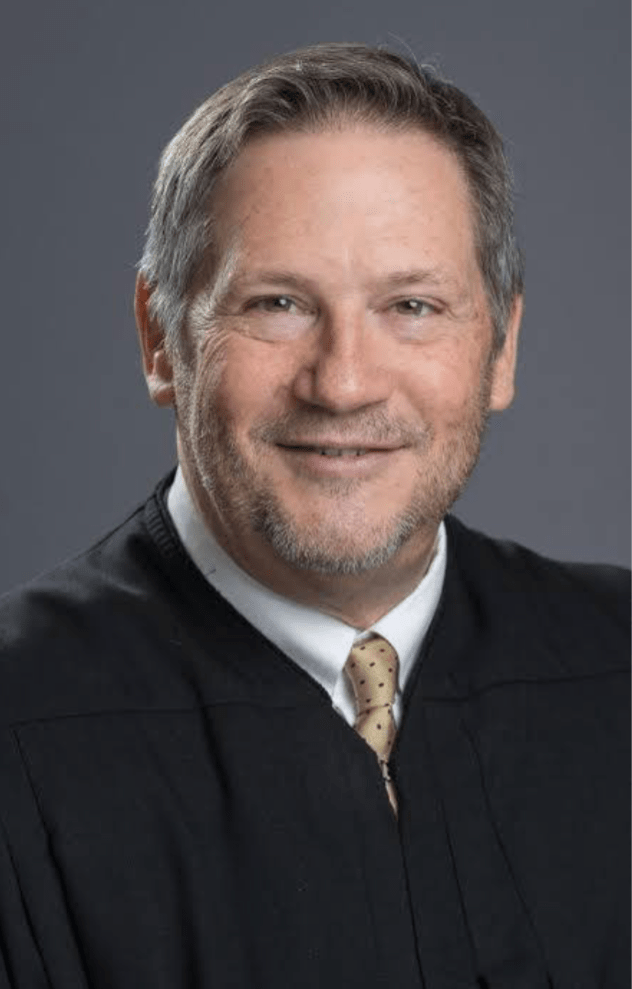
I recently had the pleasure of meeting Former Texas Supreme Court Justice Jeff Boyd when he visited my Plan II Junior Seminar, “Navigating Our State Capitol,” taught by Professor Randall Erben, who serves as an adjunct professor at the University of Texas School of Law. During his visit, Justice Boyd spoke to our class with remarkable clarity and humility about his early life, legal career, and the role of the courts in everyday life. His reflections left a lasting impression on our class, and I was fortunate enough to continue the conversation through a written interview with The Courtroom Chronicler. In this interview, Justice Boyd discusses his upbringing, moments that shaped his life before law school, his choice to enter the legal profession, the beginnings of his legal career, and his long tenure on the Texas Supreme Court before retiring this year.
Before we delve into the interview, I think it is helpful to understand the path that led Justice Boyd to serving nearly thirteen years on the Texas Supreme Court. To examine this, we must start in 1983. Justice Boyd’s journey began in 1983 when he graduated with a degree in Biblical Studies from Abilene Christian University. During his time at Abilene Christian University, he was involved in the student senate and served as president of his junior class. After graduation, he spent five years as a Youth & Family Minister at Brentwood Oaks Church in Austin, Texas. In 1988, he enrolled in Pepperdine Law School, where he served as the Editor-in-Chief of the Pepperdine Law Review and received the United States Supreme Court Historical Society Writing Award during his 3L year. After graduating summa cum laude in 1991, he went on to serve as a judicial clerk to Judge Thomas M. Reavley of the United States Court of Appeals for the Fifth Circuit from 1991-1992.
After completing his federal clerkship, he joined Thompson & Knight LLP as a trial associate in its Austin office. He worked at Thompson & Knight from 1992-2000, and became a partner in the firm in 1998. In 2000, he was appointed as the Deputy Attorney General for Civil Litigation under then-Attorney General John Cornyn, overseeing the state’s civil-litigation divisions until 2003. In 2003, he returned to Thompson & Knight as a senior partner and remained there through 2010. In January 2011, he joined the Governor’s Office as General Counsel, and later that year, he started serving as the Chief of Staff to Governor Rick Perry. A little over a year later, Perry appointed him to Place 7 on the Texas Supreme Court, filling the seat vacated by Justice Dale Wainwright, who resigned to enter private practice. Justice Boyd went on to serve on the court for nearly thirteen years.
In September 2025, Justice Boyd announced his intent to retire from the Texas Supreme Court and not seek re-election in 2026. In his statement, he wrote, “I am honored and blessed to have served on the Texas Supreme Court these past 12 years. I’m especially grateful to Governor Rick Perry for appointing me to the Court in 2012, to the many Texans who have encouraged, supported, and voted for me through two statewide elections, to my many Court and campaign colleagues and co-workers for their friendship and inspiration, and to my wife Jackie and our children for reminding me daily of life’s most important blessings. It’s now time to let another take the helm.”
After announcing his retirement, Chief Justice Jimmy Blacklock reflected on Justice Boyd’s tenure, stating that “throughout his service on the Supreme Court, Justice Boyd has been a model of integrity, impartiality, and diligence. His sharp insights and thorough analysis have shaped and strengthened the opinions of the Court, and his abundant good humor around the office have made him a beloved friend and mentor to Justices and staff alike. Justice Boyd leaves the Supreme Court, and the law of our great State, better than he found it.”
With Justice Boyd’s legal career, character, and service to the state of Texas in mind, I had the opportunity to speak with him for The Courtroom Chronicler. I hope you enjoy the interview and find inspiration in his reflections on law, life, and public service.
Part I: Early Life
Keerthi Chalamalasetty (KC): Thank you so much for agreeing to do this interview, Justice Boyd! I really appreciate your time. During your visit to our class, your reflections on your career and the overall judicial system left deep impressions on us. Your willingness to continue that conversation here means a lot to me and to the readers. Thank you again for making the time to share your experiences and insight.
To get started, can you tell me a bit about your early life and upbringing?
Justice Jeff Boyd (JB): Thank you, Keerthi, for asking me to visit with you further after my visit to your UT class. I’m glad to hear that someone thought our visit about the judicial branch was helpful! I’m the third of four kids born to a young couple who had chosen a life in the U.S. Air Force. I was born at Keesler Air Force Base in Biloxi, Mississippi, but moved from there before I turned one and ended up moving eight more times before I graduated from Round Rock High School in 1979. We lived in Germany, Japan, Texas, Oklahoma, Mississippi, Alabama, and Maryland through those years, regularly packing up the station wagon and heading off to the next assignment. It was always difficult to leave behind friends and familiar places, but I learned a lot of important life lessons because of that experience.
KC: You mentioned in class that you originally did not plan on pursuing a legal career. What experiences in your life led you from ministry to law school?
JB: It’s really hard to say. I didn’t have any other lawyers in the family and only knew a couple in my lifetime, so I really had no idea what law school or lawyering would be like. I was happy working in Christian ministry for a local church, but I didn’t think I’d do that forever, and I had gotten married, and we were starting to plan for children, and I felt like I needed to get a graduate degree of some type. I actually started at the Master of Social Work program at UT—part-time while still working in ministry—but a family illness required me to drop out in the middle of my first semester. Several months later, as I was trying to decide whether to restart that process, a friend and former college roommate called and said he had decided to take the LSAT and asked me to take it with him. It’s a long story, but the end result is I agreed, he ultimately backed out, I took it anyway, and doors were opened. He’s still my closest friend and has never taken the LSAT.
KC: You decided to attend Pepperdine Law School and were there from 1988-1991. What was your time at Pepperdine like? Were there any particular classes, mentors, or experiences that influenced your early legal career? I also know you served as the Editor-in-Chief of the Law Review during your 3L year, what was that experience like?
JB: I loved Pepperdine Law and still do. My wife and I have always agreed that those were the best three years of our early lives. Pepperdine was perfect for me—offering a challenging and respected legal education in a very student-oriented environment with numerous unique experiences. At the end of the summer before my third year, for example, I got to take a two-week course on the constitutional separation-of-powers doctrine, limited to 12 students and taught by U.S. Supreme Court Justice Antonin Scalia. As a first-gen law student, I really had no idea how valuable that experience was at the time. Our legendary Dean, Ron Phillips, and professors like Bob Cochran, Janet Kerr, and Bernie James took a very personal interest in each student and, in particular, helped me understand how the practice of law fit within my desire to live out my Christian faith.
KC: Shortly after graduating from Pepperdine, you clerked for Judge Thomas Reavley of the Fifth Circuit Court of Appeals, what was this experience like? What did you learn from your year with Judge Reavley?
JB: Judge Reavley was a highly respected Texas attorney, public servant, and Texas Supreme Court Justice before he became a judge on the federal Fifth Circuit Court of Appeals. Because of his well-known commitment to and teachings on attorney ethics and professionalism, he was known in those days as “The Pope of the Fifth Circuit.” He was brilliant and unbiased and the epitome of what it means to be a good judge. He could be a pretty demanding boss, so I had to work long and hard that year, but I learned so much from him, not only about good legal analysis and writing, but how to conduct yourself with the kind of integrity that garners the respect of others.
Part II: Early Career in Private Practice & Public Service
KC: After completing your federal clerkship, you spent several years at Thompson & Knight and eventually became a partner. What drew you to private practice, and what areas of trial work did you specialize in?
JB: I think my ministry experiences as a teacher (and occasional preacher) led me to think I should consider litigation as my legal path. Thankfully, Pepperdine’s career office told me about summer clerkships near the end of my first year in law school, and the idea of getting paid pretty good money to experience law-firm work sounded great. But my wife and I wanted to end up back in Austin if possible, so I just pulled out the old Martindale-Hubbell directory and sent my resume to dozens of Austin firms—everything from the big firms to little solo and small practices. I really had no idea what I was doing but was fortunate to line up about a dozen interviews over that spring break, and those led to some great summer clerkships. I ended up choosing to go to Thompson & Knight after my judicial clerkship mostly because my wife and I were ready to start having kids, and the attorneys I worked with there—people like Chip Brees, Debbie Alsup, and Jim Cousar—seemed to really understand the importance of balancing work and family life. It turned out to be a great decision, as I was able to get really good experiences under their guidance handling various kinds of personal-injury cases on the defense side—including professional liability (defending doctors and lawyers), premises liability (various kinds of property owners), and product liability (involving everything from excavators to artificial hips to asbestos-containing products).
KC: In 2000, you got appointed as the Deputy Attorney General for Civil Litigation under John Cornyn. What made you decide to switch from private practice to public service? What did you learn during this period of your life?
JB: I had gotten acquainted with then-Texas Supreme Court Justice John Cornyn through the Robert Calvert American Inn of Court (a great organization, and I encourage all lawyers to get involved with one of their local Inns of Court!). When he resigned from the Court to run for Texas Attorney General, he coincidentally joined Thompson & Knight as Of Counsel, so we were able to work on a couple cases together. About a year and a half after he became Attorney General, he called me to his office out of the blue, said his Deputy for Civil Litigation was resigning unexpectedly for personal reasons, and asked me to take the position. I didn’t really know anything about the position or even the AG’s office, and I had only recently made partner at the firm, but it seemed to me when you get asked to do something like that, you can’t say no. So I dropped everything at the firm and took on what turned out to be the best lawyering gig I’ve ever had. General Cornyn was great to work for, but the real benefit was working with and learning from all the division chiefs and assistant AGs who, on paper, “worked for me.” They opened my eyes to what it means to be a true public servant, to be an expert in a particular legal field, and to all the many ways that state government interacts in peoples’ lives, for the good or the bad.
KC: After working for the Attorney General for three years, you returned to Thompson & Knight as senior partner. How did your time at the Attorney General’s office change the way you approached your work once you returned to private practice? What benefits did stepping outside of private practice bring to you when you came back?
JB: Leaving T&K for the AG’s office turned out to be a great move because I was able to build extensive knowledge, experience, and even some expertise in the area of government litigation. When I returned to the firm, they asked me to build a new Government Litigation Practice Group, helping to coordinate and market all the many different ways the firm’s attorneys were already helping clients solve legal problems with the state government. It was a fun way to practice because, although I was able to litigate a few cases and argue a few appeals, I mostly provided what I called Litigation-Avoidance Services—helping clients solve disputes with the State as quickly and efficiently as possible and without the need for litigation. The truth is you can win a case against the State and still end up the loser because the State has nearly unlimited resources and can come back after you when it wants. I learned from my time at the AG’s office that what most clients need is a lawyer who will help them solve the problem, build better relationships, and get back to fulfilling their business purposes.
KC: In 2011, you returned to public service, this time joining Governor Rick Perry’s office, first as General Counsel and then as his Chief of Staff. What was it like serving as the Chief of Staff to the Governor? What did you learn from this part of your career? How was this different from what you had done in the past?
JB: Much like my path to the AG’s office, my journey to the governor’s office was also unexpected. I did not know Governor Perry, but I ended up handling a few Election Code cases for his political campaign because I knew a few people who worked for him. Out of the blue, I got a call asking me to drop everything and take over as his general counsel before the 2011 Legislative Session began a few weeks later. Again, I couldn’t see how I could say no when the Governor calls and asks you that. After we got through the session, Governor Perry asked me to take over as Chief of Staff. This was not a lawyering job, and I was not a political player or a policy wonk, but it was certainly the most difficult, fun, and rewarding job I’ve had. Perry was off running for President, so I was basically running the state, but I was blessed with an amazing team of people who knew all I didn’t know about politics, policy, communications, and the like. All I really had to do was help them do their jobs, and they were the best.
Part III: Texas Supreme Court
KC: You mentioned in class that you were initially tasked by the Governor to put together a list of candidates that he could potentially appoint to replace Justice Wainwright. Can you walk me through how your appointment to the Texas Supreme Court came about? What was your thought process when you learned that the Governor intended to appoint you to this position instead of the people that were on the list?
JB: I knew that as the Governor’s Chief of Staff I was in a pretty good position to ask him to consider me for the appointment. And of course it was an appointment I’d be happy to receive. But I was hesitant to have to deal with the politics of actually being the candidate on the ballot, and I also had three kids now attending private universities. So I decided it was time to head back to private practice and make some money and not to throw my name in the hat. We interviewed 20-30 applicants, and I gave him a list with the three or four at the top who I thought he should pick from. A few weeks later, he thanked me for the list and said, “There are some great options on that list, but I’m not going to appoint any of them because you’re going to be the next Supreme Court Justice.” I immediately told him no and explained that I needed to return to private practice and, anyway, was hesitant to get into politics. He kicked his boots up on the table and leaned back and said, “Jeff, God’s going to take care of the money, and I will help you with the politics.” Of course, I couldn’t say no to that.
KC: During your nearly thirteen years on the Supreme Court, what was your most memorable experience on the court? Are there any cases or moments that stood out to you the most?
JB: I don’t think most people know how demanding that job is. I know I didn’t until I got there. I suppose I thought having the luxury of deciding which cases to hear and then having several weeks to decide them and write an opinion would be a pretty cushy gig. But the Court receives 20-30 petitions every week, and hears and decides over 100 cases a year. Plus, the Court has many administrative responsibilities as head of the State’s judicial branch. I have no doubt that I “billed” more hours per year as a Justice than I did in any other job I’ve had. But I really loved it. I loved seeing all the new issues and how the law works to solve them, I loved oral arguments, I loved finishing a judicial opinion (I probably also loved the actual research and writing process, but for me it was always very grueling), and I loved getting to work with my brilliant colleagues, even when we disagreed with each other. But I can’t say there’s any one particular experience or one particular case that is the “most memorable.”
KC: You mentioned during your visit that when conducting your reelection campaign, you and your wife visited over 200 courthouses across Texas, which I and many others in the class found to be completely fascinating. What motivated you to do that, and were there any moments or places that were your favorite?
JB: In 2013, my wife and I were driving back from a campaign event and passed through DeWitt County, and when she saw the beautiful, historic courthouse, she suggested we stop and take a photo. About thirty minutes later, we came into Gonzales County on what turned out to be “Come & Take It Day,” so the town square was full of people, and that beautiful courthouse was surrounded by Come & Take It flags, so we had to stop and take another. After another thirty or so minutes, we figured, why not stop again as we passed through Caldwell County. We started posting the photos with a little blurb of historical information, and the social media responses were really positive. So a couple days later, when I had to drive up to an event at Baylor Law School, I left a little early and stopped for photos in Williamson, Bell, and McLennon Counties. I was by myself, so for those stops—and for many thereafter—I had to introduce myself to someone who happened to be nearby and ask them to take the photo for me. I met a lot of friendly Texans by the time I finished my second campaign in 2020 and got photos of me in front of about 240 of the 254 Texas counties. I only had to take a selfie once—I couldn’t find anyone in Hondo as I passed through Medina County early on a Saturday morning.
KC: Reflecting on your years on the Court, can you walk the readers through how a case even progresses to the Texas Supreme Court? From the moment a petition is filed to collaborative discussions, oral arguments, opinion drafting, and final ruling?
JB: The Texas Supreme Court (like the U.S. Supreme Court) is a court of “discretionary jurisdiction,” meaning the Court has discretion to decide whether to accept, hear, and decide any particular case. So the first step is for a party who is dissatisfied with the decision of a lower court to file a “Petition for Review,” asking the Court to review the lower court’s decision. The Court receives around 1,000 PFRs every year and agrees to decide around 100. Each of the nine Justices reviews each of the PFRs (our votes are due on each weekly bunch of 20-30 by noon every Thursday) and votes whether to deny, grant, study, or hold it. If all nine Justices vote to deny a case, it will be denied in orders issued the next day. If even just one Justice votes to discuss or study or hold a case, it will not be denied but instead will be put on the agenda for the Court’s next in-person meeting, which is called the Court’s “conference.” At each monthly conference, the Court will discuss all of those petitions that weren’t quickly denied and decide then whether to deny, study, or grant them. If the Court grants a petition, it will set the case for oral arguments and will draw random index cards to determine which of the Justices will be responsible for writing the Court’s opinion in the case. Oral argument will occur before the Court a few months later, the Court will discuss the case again at the next conference, and then the assigned author will start writing the opinion. Another Justice may disagree and write a dissenting opinion, and all the others will decide which side they agree with.
Part IV: Retirement & Advice to Students
KC: After announcing your decision to not seek reelection and retire, how would you reflect on your time on the Court? What are you the proudest of during your tenure?
JB: Serving on the Court was a great honor and a great challenge. Ultimately, I’m very proud of the fact that I always worked hard to get every case right, maintained complete independence to stick with my own good-faith conclusions, and helped promote good fellowship among the Court and its staff.
KC: Now that you are entering the next chapter of your life, what is next for you? Are there any personal pursuits that you are excited for?
JB: I’m most excited to have time to focus on the more important things in life—my new grandson, my aging father, the rest of my family, and my own health. And golf. I’m hoping to play more golf. I do expect I’ll start taking on some legal work in some form or fashion after the holidays and new year, but I’m intentionally not letting myself rush into that.
KC: Before we conclude the interview, is there any advice you would like to share with students or just anyone reading this today? Is there a guiding principle or life lesson that is especially important to you?
JB: I think the best advice I can give comes from the things I learned from my mentors—my law school professors, Judge Reavley, my T&K colleagues, Senator Cornyn, and others. And that is, whatever professional path you choose to pursue, don’t take it or yourself too seriously. Do something that you enjoy and are equipped for, always give it your very best, and never let it become more important than your family, your faith, and the inherent value of those you encounter each day.
*I want to extend my sincere thanks to Justice Jeff Boyd for kindly agreeing to this interview and to Professor Randall Erben for connecting me with Justice Boyd when I initially expressed interest in interviewing him.

 The Courtroom Chronicler
Leave a reply to chnvganesh Cancel reply